
In 1937, Ronald Coase asked why firms exist at all: if markets coordinate so well, why is the economy not pure atomized exchange, every task bought piece by piece instead of bundled inside a company? His answer was a balance of two costs. A firm exists because coordinating work inside it is sometimes cheaper than transacting for that work across a market, and the boundary of the firm falls wherever those two costs cross. Collapse the cost of coordinating inside the firm, then, as agentic AI now threatens to, and Coase’s own logic says the firm should dissolve into the market around it. It does not. So what is the shape of the thing left standing when coordination is nearly free, and which parts of a company turn out to be the parts that cannot be delegated away?
That is the question this essay chases, and it is the third time this sequence has reached for the same 1937 paper to chase one. An earlier essay argued that firm boundaries are Turing patterns: activation (coordination gain) against inhibition (organizational overhead), with technology modifying the substrate’s diffusion properties. The Economic Anomaly of the AI Agent argued that the contextualized agent collapses the fixed cost of internal software production, driving the Coasean boundary inward until the binding constraint becomes the principal’s coordination capacity. This essay picks up exactly where that sentence ended: what happens when the coordination capacity itself gets delegated?
The Cleanest Statement of the Claim
The sharpest public version comes from Jack Dorsey. In a Sequoia-hosted essay from March 2026, he argues that Block is building a company organized “as an intelligence rather than a hierarchy.” The essay walks from the Roman contubernium through Prussian general staffs to modern matrix organizations, frames all of it as successive workarounds for a single constraint (a human leader can manage three to eight direct reports, so scale forces layers, and layers slow information flow), and then claims that agentic AI plus a continuously-updated “company world model” can replace the routing function that middle management was invented to perform.
Block dissolves the middle. Three roles remain: individual contributors who build capabilities, directly responsible individuals who own outcomes, and player-coaches who combine craft with people development. No permanent middle management. The “edge” (humans making ethical, novel, or high-stakes calls) is preserved because the model cannot reach there. Everything else is routing, and routing is what AI does.
This has been circulating among AI-native executives for eighteen months, but Dorsey states it more plainly than most, which is what makes it worth testing: the assumption the other versions leave implicit is here on the surface, where it can be examined.
Coordination as Transmission
The argument runs on a particular sense of the word information. Hierarchy “routes.” It “aggregates information from below” and “relays decisions from above.” Middle managers “process information” and “pre-compute decisions.” The verbs treat organizational coordination as a transmission problem: sender, channel, receiver, with the middle-management layer as lossy repeaters between levels. If that is all coordination is, then yes, a world model fed by machine-readable artifacts can replace the routers.
This is “information” in the Shannon sense: messages, signal through a channel. It is not “information” in the sense Nonaka or Boisot would use.
The distinction matters because it does a lot of quiet work. The claim that artifacts plus a world model can substitute for the routing layer rests on an equation between what hierarchy carries and what can be written down as an artifact. That equation is the thing to inspect.
The Tacit Wedge
The equation fails on what hierarchy is actually carrying. Nonaka’s SECI model1 describes organizational knowledge as created through a cycle between tacit and explicit, not transmitted down a channel, and its tacit end never fully codifies: it lives in context, apprenticeship, and the feel of a situation. Boisot’s I-Space2 puts coordinates on the consequence, a firm’s valuable knowledge sits in the uncodified, undiffused corner, exactly where a corpus-fed world model cannot reach. Polanyi stated the root of it earliest and most plainly: we can know more than we can tell.
Apply this to Dorsey’s world model. He writes that “everything we do creates artifacts. Decisions, discussions, code, designs, plans, problems, and progress all exist as recorded actions.” That sentence is the streetlight effect in remote-first drag. Email, Sharepoint, Jira, Slack, ERP tables, design files: these are traces indexed against a shared understanding that lives outside them. “Let’s go with option B” is uninterpretable without the meeting that produced A, B, and C, and that meeting was deliberately not written down for political, legal, or face-saving reasons. The corpus is saturated with the codified and diffused corner of I-Space and systematically depleted in the uncodified and undiffused corner, which is exactly where proprietary advantage lives.
Dorsey partly concedes this. The “edge” in his model is where “people reach into places the model can’t go yet”: intuition, opinionated direction, cultural context, trust dynamics, the feeling in a room, ethical calls, novel situations. That is tacit knowledge by another name. He has not refuted Nonaka. He has restated him, with the middle codification layer removed.
So the real claim is narrower than it sounds. Not: AI routes knowledge. But: AI routes the subset of organizational context that was always codifiable, and that subset was what middle management actually spent its time on. Whether that subset is most of what hierarchy does or a thin slice is the empirical question. Everything downstream in Dorsey’s essay assumes the former.
The Inhibitor Goes Non-Local
The earlier essay left off at the Digital Rupture: the activator (coordination gain) went non-local because an API call from Sao Paulo to Dublin costs the same as one from the next building, while the inhibitor (organizational overhead) stayed partly local, because legal jurisdiction, management attention, cultural friction, and time zones all still attenuated with distance. That asymmetric rupture produced the platform pattern everyone now recognizes: sharp-edged, winner-take-all plateaus, nested inside one another, with a bimodal size distribution, a few giants and a long tail of minnows.
Agentic AI changes the other diffusion rate.
If a world model can maintain uniform context across an entire organization, and if an intelligence layer can compose capabilities without management mediating between them, then management overhead stops attenuating with organizational distance. The inhibitor propagates at model speed, not at meeting speed. A decanus in a Roman contubernium,3 a centurion in a cohort, a regional VP in a matrix organization: these existed because routing cost grew with scale. If routing cost stops growing with scale, the inhibitor’s characteristic diffusion range collapses toward the model’s context window.
This is a different regime again. The activator and the inhibitor both go non-local. In the reaction-diffusion simulation from the earlier essay, this corresponds to a parameter region the visualization does not yet highlight: the substrate supports neither localized spots nor platform plateaus, but something closer to the serverless limit. Ephemeral structure condensing around specific opportunities and dissolving when the opportunity ends.
Whether that regime actually obtains in practice depends on how much of the inhibitor is genuinely delegable to the model. Which returns us to the tacit wedge.
Henderson-Clark on the Control Plane
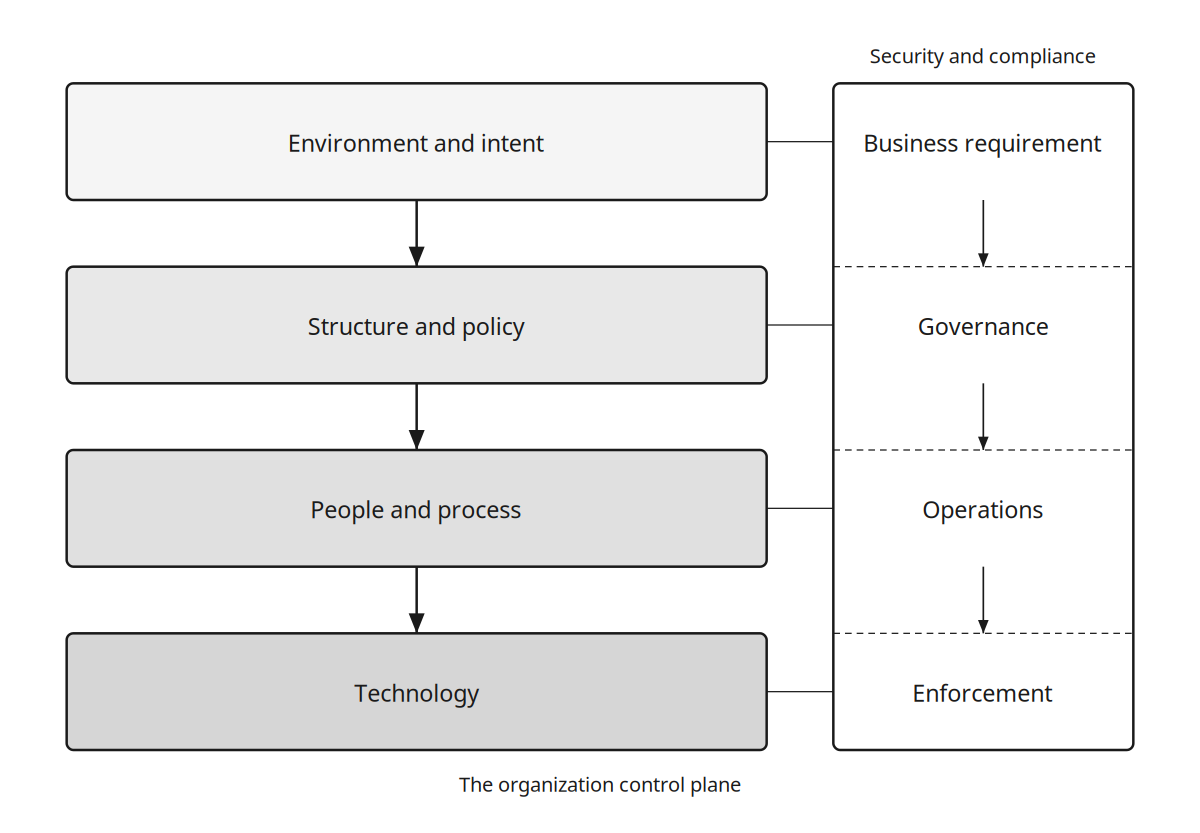
I have been sitting with a four-layer model of organizations for a while.4 Call it the Control Plane:
- Environment and Intent. Laws, regulations, market conditions set external constraints. Mission and strategy define direction. Together they shape what the organization must comply with and what it aims to achieve.
- Structure and Policy-Control. Structure defines roles, decision-making, and coordination. Policies and controls enforce compliance, mitigate risks, and provide governance.
- People and Process. People execute the mission, make decisions, drive progress. Processes provide structured workflows ensuring consistency and adherence to policy.
- Technology. Technology supports the other three. It automates tasks, ensures compliance, enhances efficiency.
Security and compliance read across all four layers as business requirement, governance, operations, and enforcement respectively.
Rebecca Henderson and Kim Clark’s 1990 paper on architectural innovation classifies innovation on two dimensions: whether core concepts are reinforced or overturned, and whether linkages between components are reinforced or overturned. Four quadrants result:
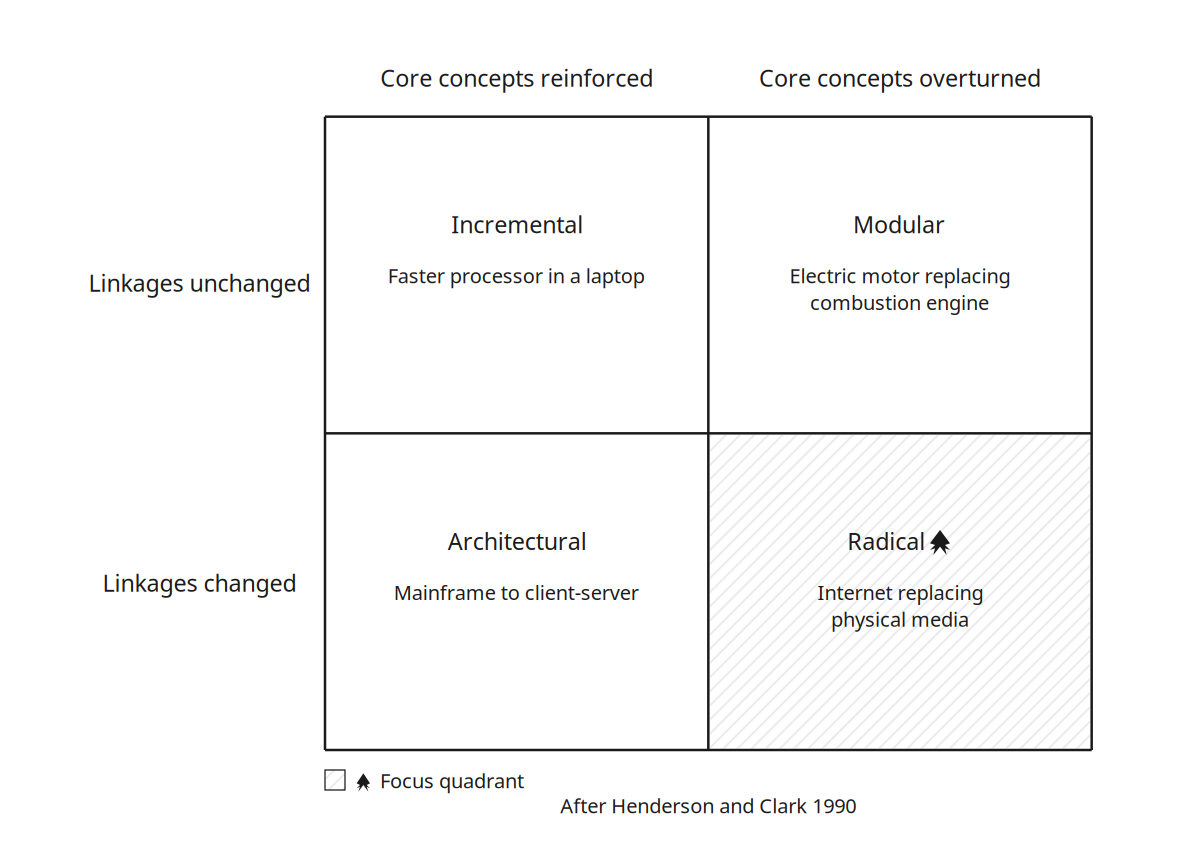
Most innovations are incremental. Occasionally a component is replaced without disturbing the architecture (modular, e.g. a faster processor in an otherwise unchanged laptop). Architectural innovation reconfigures how components interact while leaving the core concepts alone; radical innovation overturns both. The reason the framework matters is that incumbent firms reliably miss architectural innovations, because their organizational structure mirrors the old linkages and cannot see past them.
Apply Henderson-Clark to the Control Plane. Agentic AI started life trapped in Layer 4 as Robotic Process Automation. That was incremental innovation: same concepts, same linkages, slightly faster execution. Current enterprise deployments (Copilot for everyone) are mostly still incremental. What Block is describing and what Anthropic’s Cowork plug-ins are early examples of is architectural innovation: the concepts (humans as decision-makers, management as routing, product teams as roadmap owners) remain intact, but the linkages between Layers 2, 3, and 4 reconfigure. Structure stops routing through People and starts routing through Technology directly.
Dorsey is asserting that the endpoint is radical: both concepts and linkages overturn. The core concept that management exists to route information dissolves. The linkages of reporting, approval, and escalation dissolve with it.
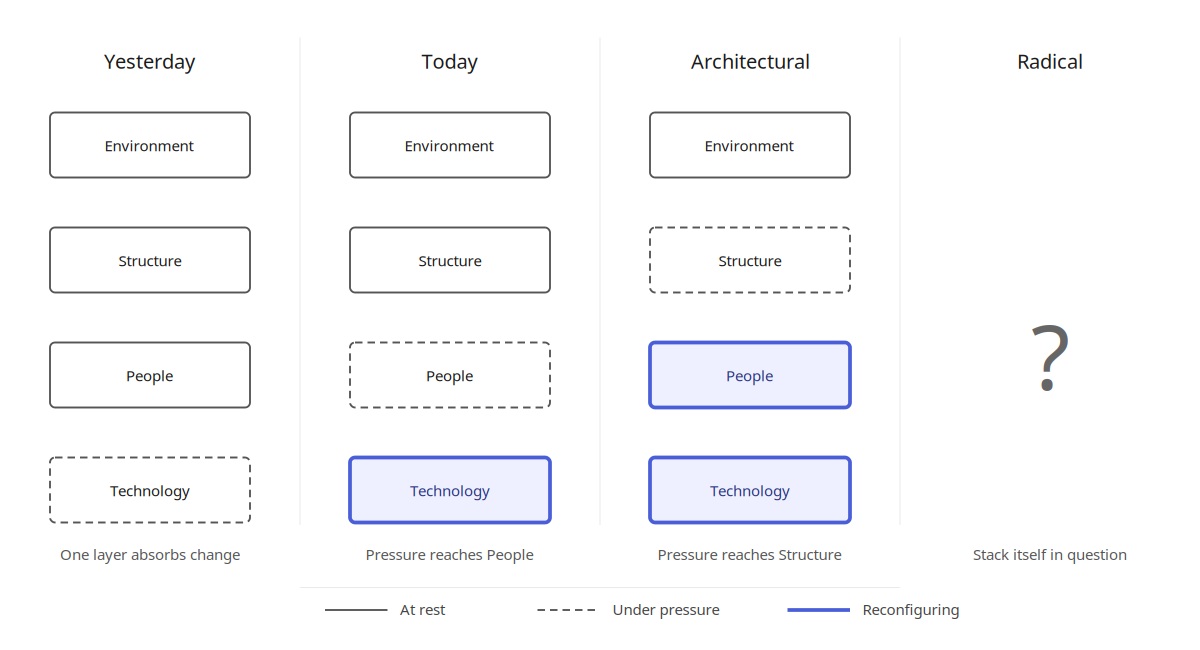
My private version of this slide had a question mark in the Radical quadrant. Dorsey’s essay is an attempt to fill in that box. The argument of this essay is that the attempt is half-successful in a specific way: the architectural transition from layered to model-mediated coordination is underway and visible. The radical endpoint depends on whether the Structure/Policy and People layers can be re-architected around non-human agents before the tacit substrate erodes. That is the empirical question Dorsey glosses.
The Spindle
If you push Dorsey’s argument to its logical end while respecting the tacit wedge, you arrive at an organizational spindle: narrow at both ends, wide in the middle.5
At the top: a thin, human-anchored regulatory shell. Environment and Intent. Legal personhood, fiduciary duty, licensing, tax liability, compliance signature, board accountability. This layer does not agentize because its whole function is to assign responsibility to a persistent, legally-accountable entity. You cannot enforce against a model.
At the bottom: a thin, human-anchored tacit edge. The irreducible judgment, ethical, and relational work that Dorsey correctly relocates to the edge. Intuition, novel situations, high-stakes calls, the feeling in a room, political and cultural context, trust dynamics.
In between: the entire middle of the organization, AI-mediated. Capabilities, the company world model, the customer world model, the intelligence layer that composes capabilities into solutions, and the interfaces that deliver them. This is where the Coasean boundary from The Economic Anomaly of the AI Agent moves to: the fixed cost of internal middle-layer production collapses, and what used to be bought from SaaS vendors or coordinated through middle management gets built and routed internally by agents.
Dorsey describes the endpoint as a cone narrowing upward toward him. That is not wrong; it is the CEO-eye-view of a more general structural shift. The founder and the edge humans are the tacit compound.
The Nature of the Firm, Again
The paradox from the opening returns here as a destination. If AI collapses internal coordination cost by an order of magnitude, Coase’s own logic predicts the firm boundary retreats toward the market. The logical endpoint is the serverless limit: ephemeral firms spun up per opportunity, drawing from capability markets, dissolved when the opportunity ends. It is organization as a service, incorporation just in time.
But Coase also named what survives the collapse of coordination cost: asset specificity, residual claims, reputation, relational capital, regulatory standing. These do not dissolve with routing cost. They are the gravity well of the persistent firm.
Dorsey’s own framing admits this, in a sentence that is Coasean to the core. “What does your company understand that is genuinely hard to understand, and is that understanding getting deeper every day?” That question asks for the irreducible tacit compound: the understanding that cannot be bought on a market, that compounds through use, that lives in the firm’s proprietary signal and its accumulated judgment. If the answer is nothing, Dorsey writes, AI is just a cost optimization story. If the answer is deep, AI reveals what your company actually is.
This is Coase’s residual, stated by a founder who frames it as strategy. The firm that survives the agentic-AI transition is the one whose tacit compound cannot be marketized. Everything else is coordination cost, and coordination cost is what AI is eating.
The Gravity Well
Organization as a Service collides with a structural obstacle. Legal personhood, in the regulatory sense, exists to assign liability, extract tax, serve as a target of enforcement, and carry fiduciary duty. An AI person with no assets, no continuity, and no human principal is enforcement-proof, and regulators will not allow that to stand at scale.
The likely outcome is a two-tier structure: short-lived AI-mediated execution shells wrapped in persistent human-anchored holding entities that carry the regulatory weight. This already exists in compressed form as special-purpose vehicles, shell structures, and fund-of-funds architectures. What changes with agentic AI is that the execution shells get cheaper by two or three orders of magnitude, and the rate of incorporation and dissolution accelerates accordingly.
Software learned this lesson already. Pure statelessness is a lie. You push state somewhere, and that somewhere becomes the gravity well. For firms, the state lives in regulatory standing, fiduciary duty, licensing, reputation, asset specificity, and accumulated tacit compound. You can make the execution layer ephemeral. You cannot make the state layer ephemeral without dissolving the things that make the firm legible to its environment.
The top of the Control Plane is the hardest layer to agentize, not because the technology is behind, but because the function of that layer is to be a persistent human-accountable target.
What the Claim Gets Right, and What It Glosses
The direction is right. Agentic AI forces a structural shift in how organizations coordinate, and middle management is the first layer to absorb the impact. Productivity-copilot framings that leave the hierarchy intact are the equivalent of electrifying a horse-drawn carriage. The radical reframe is the correct reframe.
What it glosses is the path and the substrate. The tacit knowledge that middle management was incidentally carrying alongside its routing function does not live in the artifact stream. It lives in the uncodified corner of I-Space, in the socialization phase of SECI, in Polanyi’s more-than-we-can-tell. Dorsey’s architecture relocates that knowledge to the edge, which is a concession in all but name. Whether the edge can carry it without the middle is the empirical test Block is running on itself.
And the nature-of-the-firm question is prior to the organization-design question. The firm that survives this transition is defined by what it understands that markets cannot source. That is Dorsey’s own criterion. If the compound is deep, the spindle holds. If it is shallow, the firm dissolves into the capability market it is drawing from.
Coase met Turing in the shape of firm boundaries. Coase meets AI in the shape of the firm itself. The boundary moves inward, the middle thins, the top and bottom persist as the human-anchored anchors of a regulatory shell and a tacit edge. The shape that remains is the shape of what could not be delegated.
-
Ikujiro Nonaka’s model of how firms create knowledge, a cycle of four conversions (socialization, externalization, combination, internalization). It is here to name what Dorsey’s routing picture leaves out: knowledge is made in that cycle, not shipped down a wire, and the tacit end of it resists being written down at all. Fuller treatment: Nonaka and Takeuchi, The Knowledge-Creating Company. ↩︎
-
Max Boisot’s map of knowledge assets along three axes, codification, abstraction, and diffusion, each a costly and lossy transformation rather than a free read. It earns its place by locating a firm’s advantage precisely in the uncodified, undiffused corner, the one an artifact stream is emptiest in. Fuller treatment: Boisot, Knowledge Assets. ↩︎
-
The smallest unit of the Roman army: about eight legionaries who shared a tent and a mess, led by a decanus. Ten made a century (under a centurion), six centuries a cohort, ten cohorts a legion. Every tier existed for one reason, a commander can directly manage only a handful, so scale forces layers. That is the point Dorsey draws from the walk. ↩︎
-
The four-layer stack is mine, not a named framework, and a hand-built classification like this can look arbitrary. The honest claim is the weaker one: it is not arbitrary, because it has generating reasons. The layers are ordered by two kinds of pain: deviation, the cost of failing what a layer owes, and change, how hard the layer is to move. A value-chain reading of how technology gets absorbed into the firm supplies the third. That it resembles enterprise-architecture stacks like SABSA and ArchiMate is convergence on a natural shape, not a borrowing from them. ↩︎
-
Hourglass would be the more natural single word, but it is already taken in the adjacent AI-and-consulting literature with a different and incompatible geometry. Gesikowski (2025), responding to HBR’s pyramid-to-obelisk reframe of the consulting structure, proposes an hourglass of wide AI platform at the base, narrow human delivery at the neck, and wide outcomes at the top: humans as the neck between AI-generated analysis and client-facing delivery. The shape described here is the geometric inverse: narrow human anchors at both ends, wide AI-mediated execution in the middle. Humans as the two endpoints rather than the central neck. Both describe the same underlying mechanism (AI compresses the codifiable part of the firm) with different anchoring. The consulting-firm case keeps humans at the neck because their product is the human judgment in the delivery layer. The operating-firm case under Dorsey’s regime pushes humans to the endpoints because the middle is exactly what AI replaces. Using hourglass for both would collapse a distinction worth preserving. ↩︎