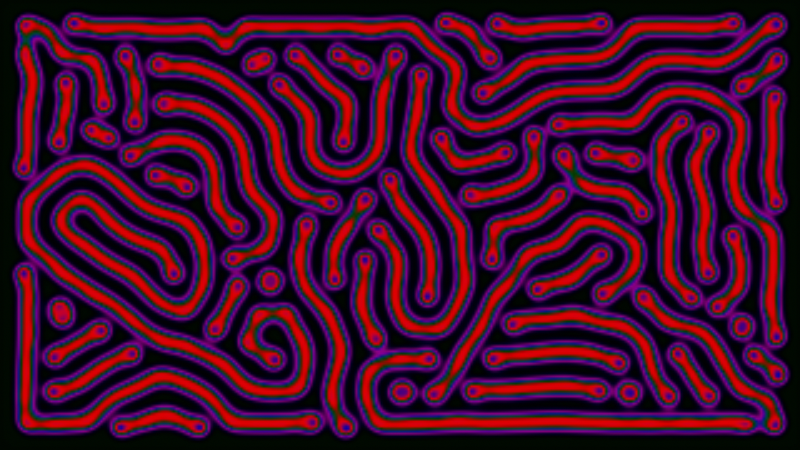
In 1937, Ronald Coase asked a question that economics had somehow never asked: why do firms exist at all? Why is the economy not one giant firm, or pure atomized exchange between individuals? His answer: there are two competing cost gradients. Coordination inside a firm gets cheaper per unit as you share context and routine. But organizational overhead (management, reporting, principal-agent friction) rises faster as the firm grows. The boundary of the firm is where these two gradients cross.
In 1952, Alan Turing asked an equivalent question in biology: why do spots form on animal skin? Why is the skin not uniformly one color? His answer: two chemicals interact. One reinforces itself locally (the activator). The other suppresses at a distance and diffuses faster (the inhibitor). When their diffusion rates differ enough, bounded patterns emerge spontaneously from a uniform substrate. No blueprint. No designer. Just two forces with different ranges.
These are the same answer.
I am not a mathematician or an economist. I am someone who thinks about organizations and noticed that Coase’s boundary and Turing’s boundary are drawn by the same mechanism. This essay is that observation, carried as far as intuition takes it.
Two Forces, One Pattern
The mapping is direct.
Coordination gain is Turing’s activator. When two activities are co-managed inside a firm, they share context, routines, tacit knowledge, and trust. This benefit reinforces locally: the more you coordinate, the more there is to coordinate. But it is inherently short-range. It depends on proximity, shared language, and working relationships that do not travel well.
Organizational overhead is Turing’s inhibitor. Every additional activity inside a firm increases management burden. Meetings multiply. Reporting chains lengthen. Principal-agent friction compounds. And critically, this cost propagates faster and further than the coordination benefit. One new hire adds overhead for everyone in the reporting chain, not just the people they directly work with.
When the inhibitor diffuses faster than the activator, bounded patterns emerge. In biology, those patterns are spots on a cheetah, stripes on a zebra, or patches on a giraffe. In economics, those patterns are firms.
The boundary of the firm is not a decision someone makes. It is where coordination gain drops below the cost of organizational overhead, the edge of the Turing spot. The firm does not get designed. It crystallizes.
The Skin
In Turing’s model, patterns form on a substrate, a field of cells with specific material properties that determine how fast each chemical can spread. Change the substrate, change the pattern.
The economic substrate is everything through which coordination and overhead propagate: institutional infrastructure, economic conditions, and regulatory regimes. Money, contracts, accounting standards, corporate personhood, competition law, labor regulation, trade policy. These are not features of any individual firm. They are properties of the medium that all firms form on. This is the “skin” on which economic patterns form.
And this skin has a developmental history:
-
Barter is essentially no skin. Direct exchange, no mediating layer. No medium through which either coordination or overhead can propagate beyond the immediate transaction. No firms form.
-
Money creates the first real skin. Value can flow. A surplus in one transaction can feed another. But it is thin: coordination travels a little further, but there is no infrastructure yet for overhead to propagate through. You get faint clustering: households, small workshops.
-
Contract law thickens the skin. Agreements are enforceable across time and between strangers. Coordination range extends. But contracts simultaneously provide the first propagation channel for the inhibitor: obligations accumulate, disputes require adjudication, compliance requires monitoring. The Turing instability condition begins to be satisfied. Real firms nucleate.
-
Double-entry bookkeeping is a phase change. Overhead suddenly has a high-fidelity, low-friction channel. You can track costs and performance across large organizational spans. The inhibitor’s diffusion rate jumps. This is why the modern firm emerges when accounting technology matures: the skin acquired the material properties needed to support larger, sharper spots.
-
Corporate personhood makes the spot self-sustaining. Before it, firms dissolved when their principal died. After it, the pattern persists independently of any individual. The skin remembers the spot.
-
Regulatory regimes are external constraints on the pattern itself. Antitrust caps spot size. Licensing sets a minimum activation threshold for spot nucleation. Labor and environmental regulation modify the inhibitor’s properties (they add overhead that scales with firm activity). Securities regulation changes how capital flows through the substrate.
Each institutional layer does not just enable new firms. It changes what kinds of patterns are possible at all.
And the skin never gets thinner. It only accumulates layers. A modern economy cannot revert to bazaar morphology because the inhibitor channels are too well developed. De-patterning only happens through institutional collapse: the skin thins, firms dissolve, and the economy falls back to whatever pattern the remaining substrate supports. This is what you observe in failed states.
Technology Changes the Skin
Technology is not the skin. It modifies the skin’s material properties. I use the term lubrication for this1: technology does not create the pattern. It changes how easily the forces move through the skin.
The printing press raised both diffusion rates, but not equally. Codified knowledge (accounting methods, legal codes, management procedure) benefits most from mass reproduction. That is inhibitor infrastructure. Coordination gain, which depends on tacit knowledge and trust, benefited less. Print sharpened firm boundaries and enabled larger spots.
The telegraph and railroad extended coordination range without proportionally increasing overhead propagation. A manager in New York could coordinate with Chicago in real time, but the bureaucratic cost of managing that distance did not shrink. Result: bigger spots, same morphology. This is the era of the giant vertically integrated firm.
The shipping container did something similar in the physical dimension. Cheaper transport extended the activator’s range. Firms stretched geographically. Multinational corporations became possible.
Every one of these technologies modified diffusion rates but preserved locality. Both forces still attenuated with distance. The governing equation stayed the same. Pattern scale changed. Pattern class did not. A cheetah with larger spots is still a cheetah.
The Digital Rupture
Digital technology breaks locality itself.
An API call from Sao Paulo to Dublin costs the same as one from the next building. For any activity that can be digitally mediated, coordination gain no longer attenuates with distance. The activator goes non-local.
But overhead does not fully follow. Legal jurisdiction is still local. Labor regulation is still local. Management attention is still local: a human can only hold so many reporting relationships regardless of bandwidth. Cultural friction is still local. Time zones are still local.
This is not “better technology.” It is a qualitatively different substrate. The activator is no longer governed by local diffusion. It reaches everywhere. The inhibitor is still partly local.
And this decoupling produces fundamentally different pattern classes:
Plateaus with sharp boundaries. Local Turing spots taper off smoothly. Non-local systems produce flat-topped territories with steep edges. Inside the platform: near-total dominance. Outside: near-zero presence. You are in the ecosystem or you are not. This is how platforms actually behave.
Winner-take-all condensation. When activation reaches everywhere, the longest-wavelength mode dominates. The pattern condenses into one or very few global-scale spots. Google in search. The substrate cannot support multiple spots at that scale.
Spots with internal substructure. In local Turing systems, spots are featureless blobs. In non-local systems, a large spot sustains its own internal pattern formation. Amazon is a spot that contains a marketplace, a ranking system, sub-ecosystems. Structure inside structure. Nested morphogenesis.
Bimodal size distribution. Many small spots coexisting with very few enormous ones. Platforms plus micro-firms, with mid-size firms hollowing out. This is not an anomaly to be corrected. It is the expected morphology when one diffusion rate escapes locality and the other does not.
The current economy is living on a skin that is part local and part non-local. Activities that can be digitally mediated live on non-local skin. Activities requiring physical presence still live on local skin. The boundary between those two zones is where the most interesting economic turbulence is happening right now.
The Visualization
I built an interactive visualization that runs a Gray-Scott reaction-diffusion model, the same class of system Turing described, with economic labels on the parameters. You can drag sliders and watch economic morphology change in real time.
Things to try:
-
Start with “Artisan.” You see many small, well-separated spots, firms of similar size in a competitive market. Now slowly drag Coordination Range to the right. Watch the spots merge into larger structures. You are watching what the internet did to market structure.
-
Start with “Artisan” again. This time, increase New Opportunity Rate. The clean spots connect into labyrinthine chains, into guilds.2 You just rediscovered the guild system from first principles.
-
Start with “Industrial.” Push Organizational Decay toward “Fragile.” Watch firms dissolve as institutional memory fails.
-
Start with “Platform.” Increase Overhead Reach toward “Pervasive.” Large territories fragment as regulation bites.
-
Start with “Barter.” Increase New Opportunity Rate. Watch when firms first nucleate from the empty substrate. That is the Coasean instability threshold.
The parameter-space map on the right shows where you are and what regime transitions look like. The boundaries between pattern types are sharp: you do not smoothly interpolate between spots and stripes. You jump. This is why economic transitions are discontinuous.
You can replay five centuries of economic history in four slider moves3: start at Artisan (spots), increase opportunity (labyrinths/guilds), increase coordination range (monopoly condensation), then increase overhead reach (spots re-emerge at larger scale as modern firms).
What This Is and What It Isn’t
This is an observation of structural correspondence between two well-established formal systems. It is not a proof of isomorphism.
A full formalization would require constructing an explicit activity space with a well-defined metric, deriving reaction kinetics from economic first principles, and proving that the Coasean boundary falls out as the zero-level set of the activator in the patterned steady state. That is a research program, not an essay.
What the observation gives you without the formalization is a way of seeing economic morphology as pattern formation. It reframes questions about firms, markets, platforms, and regulation in terms that make the underlying dynamics visible:
-
Antitrust maps to two distinct interventions with different morphological outcomes.4 Breaking up firms (increasing decay rate) produces many small fragile spots that may recondense. Behavioral regulation (increasing inhibitor diffusion) changes the equilibrium itself.
-
Business cycles look like metastable-state transitions.5 A boom is not firms getting bigger; it is spots connecting into labyrinths. A bust is the labyrinth fragmenting.
-
Guilds are a distinct pattern class (labyrinths), not primitive firms. They emerge when opportunity is high but coordination is local.
-
The mid-size firm hollowing out is not a market failure. It is the expected morphology for a substrate with non-local activation and partly-local inhibition.
The math may follow. The insight does not need it.
Prior Work
Nobody seems to have made exactly this mapping, but the pieces exist across several disconnected literatures. Each touches part of the structure without assembling the whole.
Krugman’s New Economic Geography (1991 onward) is the closest body of work. His core-periphery model frames the spatial distribution of economic activity as a tug of war between agglomeration forces (market size effects, labor pooling) and spreading forces (immobile factors, transport costs). That is structurally a reaction-diffusion instability analysis, and Krugman himself was aware of the formal parallel. But he worked in a discrete two-region framework (core vs. periphery), not in continuous space, and he never mapped it to Turing morphogenesis. His activator is agglomeration; his inhibitor is dispersion. The math is close but the biological pattern-formation language is absent. Critically, his question is “given this landscape, where do spots form?” not “why do spots exist as a morphological class?” The answer is always contingent on substrate features: change the coastline, move the river, and the pattern shifts. This essay asks a question that is prior to geography.
Helbing (2009) got closer to the explicit connection. He demonstrated that asymmetrical diffusion can drive social, economic, and biological systems into unstable regimes through pattern-formation instability, even from homogeneous initial conditions. His work frames this in terms of game-theoretic payoffs rather than firm boundaries, but the mechanism he identifies is Turing instability applied to social systems. He showed that you do not need pre-existing heterogeneity to get structure; the asymmetry in diffusion alone is sufficient. That is the same core claim made here, applied to a different level of economic organization.
Volpert, Petrovskii, and collaborators produced what may be the most directly relevant formal work. They built an economic-demographic model using nonlocal reaction-diffusion PDEs, showing that when resource consumption is nonlocal, a homogeneous wealth-population distribution is replaced by periodic spatial patterns, and that for global consumption of resources, a single wealth accumulation center can emerge. That is exactly the non-local activation argument in this essay producing winner-take-all condensation. They explicitly noted that intellectual resources, unlike natural resources, do not have fixed geographical location and that their transportation cost is not a limiting factor, requiring nonlocal terms in the model. Their math validates the mechanism. What they did not do is connect it to Coase’s firm boundary question.
A 2024 cross-diffusion paper took another angle. Researchers built a mutualistic model of labor and capital interaction, showed that the uniform profit-optimum becomes unstable under Turing instability conditions, and that the resulting patterns of alternating high and low concentrations can be interpreted as cities. They connect this explicitly to Turing’s 1952 framework and to Krugman’s geography models, while noting that their continuous-space formulation is more general than Krugman’s discrete patches. Again, the level of analysis is spatial (where does economic activity concentrate?) rather than organizational (why do bounded firms exist?).
A 2021 Royal Society Interface paper used a coupled economic-demographic reaction-diffusion model to show that population distributions exhibit nearly periodic spatial patterns even in uniform environments, and that Turing instability provides a plausible mechanism. This confirms that the pattern-formation framework applies to economic phenomena on featureless substrates, which is the same substrate assumption made here.
What is different here
All of these works use reaction-diffusion mathematics on economics. None of them connect it to Coase’s theory of the firm.
Krugman explains where economic activity agglomerates in space. Volpert explains where wealth concentrates. The cross-diffusion paper explains where cities form. This essay asks a different question at a different level of abstraction: why do firms exist as bounded entities at all, and what determines their characteristic scale and morphology?
The specific move is: the “spot” is the firm itself (not a city or a region), the boundary is the Coasean make-or-buy margin, and the substrate through which the morphogens propagate is institutional infrastructure (not geography). The activator is coordination gain. The inhibitor is organizational overhead. The lubrication parameter that governs pattern regime is technology’s effect on the substrate’s diffusion properties.
The economics literature has reaction-diffusion models for spatial agglomeration. It has Coasean theory for firm boundaries. It has transaction cost economics for why those boundaries shift. The pieces are all on the table. The assembly, connecting the pattern-formation mathematics to the organizational boundary question, appears to be new.
I’m not an economist or a mathematician. I’m a pattern noticer. One day, thinking about firms as features on an economic “skin,” I realized that the simplest explanation for why a uniform substrate develops bounded structures is Turing’s, and that Coase had already given the economic version of the same answer, thirty-five years earlier.
-
Lubrication is not the diffusion of either species. It is a property of the substrate itself, the medium through which both activation and inhibition propagate. In Turing’s formulation, diffusion rates are not intrinsic to the chemicals alone; they depend on the medium (viscosity, porosity, temperature). Change the medium, change the pattern. What lubrication specifically does is increase the activator’s diffusion rate. Before technology intervenes, coordination gain is sticky and local: it depends on proximity, shared routine, tacit knowledge that does not travel well. The inhibitor (overhead, complexity) already diffuses easily because bureaucratic cost scales regardless of distance. That asymmetry is exactly the Turing instability condition. When you lubricate the substrate (APIs, cloud infrastructure, standardized contracts, outsourcing platforms), you make the activator less local. Coordination can now operate across boundaries that previously confined it. The diffusion ratio narrows, and existing spots become less stable. But total equalization of diffusion rates does not give you a featureless market with no firms. It gives you a regime transition to a different pattern type. The old spots dissolve, but new instability conditions emerge around different activator-inhibitor pairs (network effects versus platform governance costs, for instance), and those produce structure at a different characteristic scale. “Lubrication” names the substrate parameter that governs pattern morphology without specifying which pattern you get. ↩︎
-
A guild is not a firm and not a market. It is precisely the labyrinthine morphology: a continuous network of coordinated activity where individual practitioners are connected through shared standards, apprenticeship chains, quality controls, and mutual obligations, but without the clean inside-outside boundary that defines a firm. No single guild member is independent (they are bound by guild rules, pricing conventions, territorial agreements), but no single entity “owns” the guild. This is exactly the morphology you would predict for artisan-level coordination range (still local, still based on personal trust) but high opportunity rate. Lots of work to organize, limited ability to project coordination at distance. The system cannot form large discrete firms because the coordination range is too short. But it cannot remain as isolated spots either because opportunities are too abundant. So it connects the spots into worms and labyrinths. The historical sequence confirms this: guilds dominated precisely when trade was booming (late medieval commercial expansion) but coordination technology was still local (face-to-face, apprenticeship, personal reputation). When coordination range extended through print, contract law, and accounting, the labyrinths broke apart and re-formed as clean spots: chartered companies, joint-stock firms, modern corporations. The guild was not replaced because firms are “better.” The guild morphology became unstable when the substrate parameters shifted into a regime that supports spots instead of labyrinths. ↩︎
-
The full historical sequence maps to four parameter changes. Start at Artisan: many small, well-separated spots. This is the pre-industrial economy of comparable-scale workshops and traders. Increase opportunity rate: the spots connect into labyrinths. This is the late-medieval guild system, driven by expanding trade routes and commercial opportunity that outpaced coordination technology. Increase coordination range (simulating oceanic navigation, chartered companies, early banking networks): the labyrinths condense into one or a few dominant structures. This is the mercantilist era of monopoly trading companies like the East India Company, where coordination technology leaped past the existing inhibitor infrastructure. Finally, increase overhead reach (simulating the development of competition law, corporate regulation, standardized accounting): the monopoly fragments back into distinct bounded structures at a larger scale. This is the liberal economic revolution of the 18th and 19th centuries, not a political choice to have competition, but a pattern regime transition driven by the institutional skin finally developing enough inhibitor-propagation capacity to support a spotted morphology at the new coordination range. Four slider moves, five centuries. ↩︎
-
Structural antitrust (breaking up monopolies, preventing mergers, forcing divestitures) is an increase in Organizational Decay. You are artificially increasing the rate at which large organizational structures lose coherence. The Sherman Act, the Standard Oil breakup, the AT&T divestiture: these are all external forces that push the decay parameter upward for specific entities. The pattern effect is that oversized spots are forced to fragment. But notice what happens when you increase decay globally in the simulation: you do not just shrink the big spots. You make all firms more fragile. You cannot target the inhibitor at one spot without changing the substrate for everyone. Behavioral antitrust (regulating conduct, imposing interoperability requirements, mandating data portability, preventing exclusionary practices) is an increase in Overhead Reach. You are adding bureaucratic and compliance cost that propagates across the entire organization. GDPR, platform regulation, mandatory API access: these all increase the inhibitor’s diffusion. The pattern effect is different. You do not dissolve the large structure directly. You change the diffusion ratio so that the substrate can no longer support spots above a certain size. The large spots shrink or develop internal fractures because the inhibitor now reaches further within them. This is slower but more stable because you are changing the substrate properties rather than attacking individual spots. The framework surfaces something that antitrust policy debates usually miss: these two interventions produce different morphologies even when they both succeed in reducing concentration. Try both on the monopoly preset in the simulation and watch the difference. ↩︎
-
In reaction-diffusion systems, labyrinthine states are often metastable rather than truly stable. When the opportunity rate drops (the boom ends), the labyrinths do not gracefully separate back into spots. They fragment chaotically: suddenly interdependent firms discover their entanglements are liabilities, and the pattern collapses into a disorganized state before reorganizing into a new set of distinct spots at whatever scale the post-crash parameters support. This is what a bust looks like in morphological terms. The boom was not firms getting bigger. It was spots connecting under high opportunity pressure, forming tangled webs of partnerships, joint ventures, supply chain entanglement, and overlapping scopes where nobody can tell where one company ends and another begins. The organizational landscape becomes a labyrinth where coordinated activity is continuous and interconnected rather than discrete and bounded. And the framework predicts what comes next: the fragmentation is not a gradual unwinding but a sudden collapse, because labyrinthine states are sensitive to parameter shifts in a way that stable spots are not. ↩︎